
Moving a Dog or Cat Across the Country: Drive, Cabin or Cargo
The short answer: three ways to cross the country, and how to pick
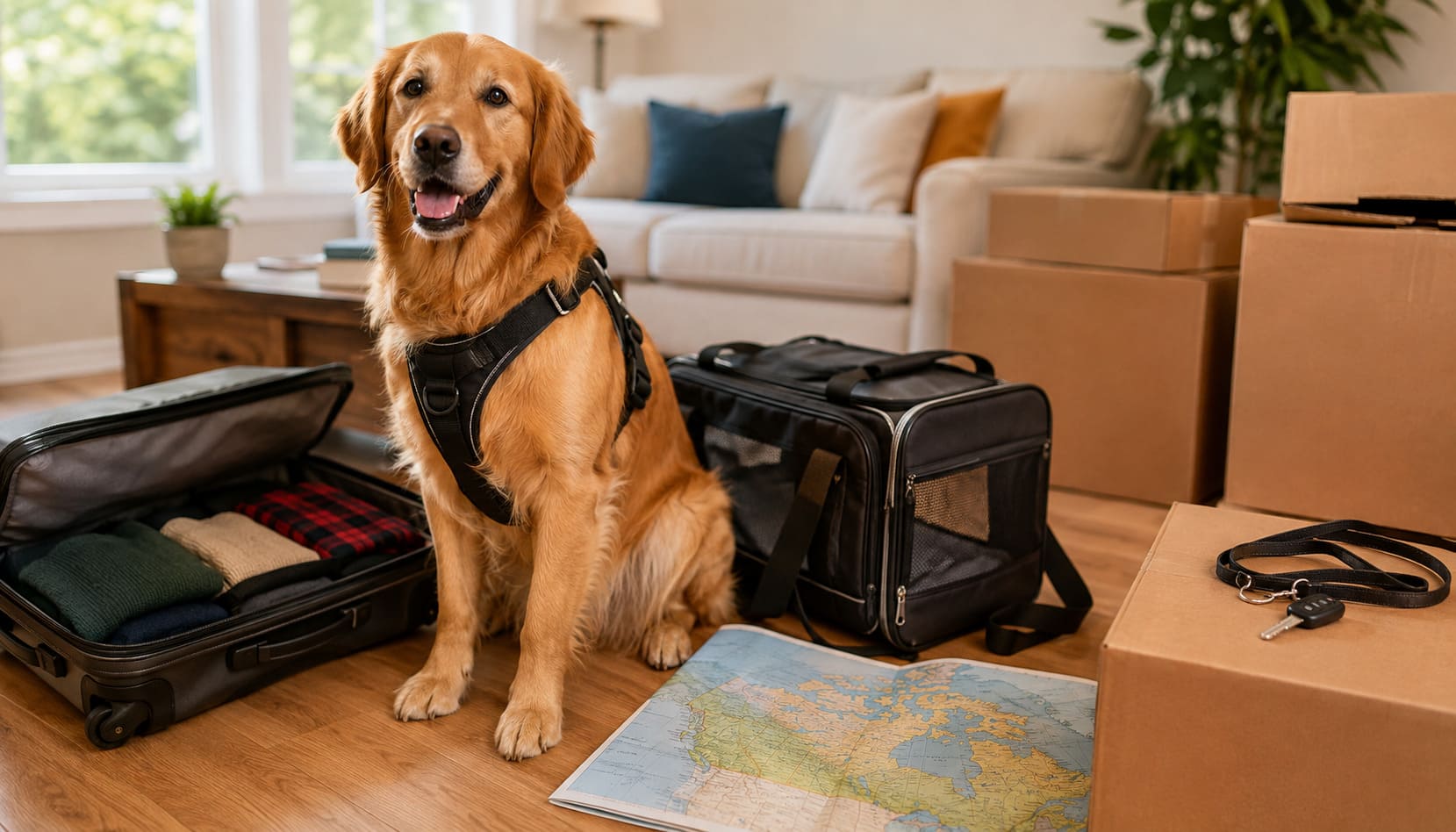
Moving a pet across Canada comes down to three options: drive together, fly with your pet in the cabin, or fly your pet as cargo. Which one is right depends on your pet’s size, the season, and how much time you have.
The quick version. A cat or small dog that fits under an airline seat should almost always fly in-cabin with you: it is the cheapest and shortest door to door option. A large dog crosses the country best as air cargo on the most direct routing you can get, unless you have the time to drive and your dog travels well by car. The drive is the right call for pets that cannot fly, for owners moving a car anyway, and for anyone who wants to stay within arm’s reach the whole way.
Here is how to think through each one properly, because the details decide whether the trip is calm or stressful.
Moving a cat? The three options work the same way for cats, and our guide to flying with a cat from Canada covers the cabin rules, the CATSA checkpoint and the carrier sizes.
First, the good news about paperwork
A move between provinces needs no CFIA export certificate, because nothing is leaving the country, and crossing from Ontario to British Columbia is not like crossing a border. What applies instead is provincial. Ontario, for example, requires a dog or cat to be vaccinated against rabies from three months old and says plainly that indoor pets are included. Check the destination province before booking the vet, not after. Airlines add rules on top: they set their own requirements for carriers, crates, and sometimes a recent health certificate for cargo travel. So the paperwork question has two halves, the destination province and the airline, and the second is one we check for every move we plan.
Two things are still worth doing regardless of how you travel. Make sure your pet’s microchip registration and tags show your new address and a mobile number that will work during the move. And carry your pet’s vaccination records with you: veterinarians, boarding facilities and some hotels along the way will ask.
Option 1: flying in-cabin, the best option for small pets
Air Canada and WestJet each publish a carrier size. Air Canada’s general limit is 40 cm wide, 43 cm long and 20 cm high, with exceptions on some aircraft, and WestJet’s is 41 cm long, 21.5 cm high and 25.4 cm wide. Air Canada and WestJet each charge $50 to $60 CAD per direction for in-cabin pets within Canada, which makes a cross-country flight the cheapest way to move a small pet by a wide margin. A Toronto to Vancouver flight is about five hours, so the whole move fits inside a single day. Compare that with four days of driving and the case makes itself.
The planning points that matter:
- Air Canada and WestJet each limit how many pets travel in the cabin, so book the pet spot at the same time as your own seat, not after.
- The carrier must fit under the seat and your pet must be able to stand and turn inside it. Soft-sided carriers give a few extra centimetres.
- Your pet stays in the carrier for the whole flight, so spend the weeks before travel making the carrier a familiar, comfortable place at home.
- Feed a light meal 3 to 4 hours before the flight, and give your pet a chance to relieve themselves as late as possible before security.
Option 2: flying as cargo, the workhorse for larger dogs
Dogs too big for the cabin travel in the hold as manifested cargo. This is the part of pet travel that owners fear most and understand least, so it is worth saying plainly: cargo is how large dogs cross this country every week, and done properly it is a safe, routine operation. Air Canada Cargo says the holds on its aircraft are pressurized and that most of them also have temperature-controlled compartments, and that where temperature control is needed but not available on the route booked, the booking agent suggests a different route or an alternate travel date. Air Canada publishes its winter rules by aircraft and temperature. From 1 November to 31 March, and whenever it is 0 °C or below, it accepts no cats or dogs under 4.5 kg in the baggage compartment of any of its aircraft and advises against animals as checked baggage on its Airbus A319, A320 and A321, whose cargo compartment is not heated. From November to March its Boeing 737 MAX 8 takes no cats or dogs in the baggage compartment at all.
What it costs. Air Canada Cargo’s charges and fees page, read 15 September 2026, says to contact a local sales representative for a quote on dogs and cats travelling within North America. Its AC Animals page for dogs and cats, read the same day, says pricing is one-way only and varies based on origin, destination and dimensional weight. For the crate itself, our pet shipping cost calculator gives the retail price by size. The crate size, not your dog’s weight, is what drives the fee, which is why an oversized crate is an expensive mistake and an undersized one is an unsafe one. The right crate lets your dog stand without crouching, turn around, and lie down flat.
What matters more than price:
- Direct flights. Every connection adds handling and waiting. A direct Toronto to Vancouver or Montreal to Calgary routing is calmer for your dog than a cheaper itinerary with a stop. If a connection cannot be avoided, leave enough time between flights that a short delay does not turn into a missed transfer.
- Crate acclimation. Start 3 to 4 weeks early: meals in the crate, naps in the crate, door open, then door closed. A dog who knows the crate treats travel day as boring, which is exactly what you want.
- Season. More on this below, because in Canada it shapes everything.
- Breed. Snub-nosed breeds like bulldogs, pugs and Persian cats face airline restrictions in cargo because of how they handle heat and stress. Air Canada will not take a snub-nosed dog in its baggage compartment. For these pets, ground transport is often the honest recommendation.
Our guide to pet air transport goes further into how the cabin and the hold compare, and into private charter.
For the full picture of what drives the numbers, our Canadian pet shipping cost guide breaks down every charge on this kind of move, and our pet shipping cost calculator itemizes the government fees route by route.
Option 3: driving, the long way that some pets need
Canada is wide. Toronto to Vancouver is roughly 4,400 km, which means about four to five days of real driving with a pet in the car. That is the main cost of driving: not money, but time and planning. It is also the only option where your pet never leaves your sight, which for anxious animals, seniors on medication, snub-nosed breeds and pets that airlines will not accept is worth every kilometre.
How to do it well:
- Restrain your pet properly. A crash-tested harness, a secured crate, or a barrier behind the back seats. An unrestrained pet in a highway stop is a danger to everyone in the car.
- Plan the overnights before you leave. Pet friendly rooms along the Trans-Canada fill up in summer. Book ahead rather than hoping at 9 pm in Wawa.
- Cats need a different setup than dogs. A large travel crate with room for a small litter tray, set up days in advance at home, makes the difference between a yowling first hour and a sleeping passenger.
- Stop every 2 to 3 hours for water and a leashed walk. Never leave a pet alone in a parked car, in summer or winter.
- Keep the routine. Same food, same feeding times, familiar bedding. The road changes every day; the routine should not.
Going by road does not have to mean driving yourself. A professional ground service covers the same distance in a climate-controlled vehicle, and it is often the better answer for a snub-nosed breed or a pet an airline will not accept. Our guide to ground pet transport in Canada covers how those services work, what they cost and when the road beats flying.
The Canadian complication: seasons
Timing a cross-country pet move in Canada means respecting two windows. In winter there are two constraints. Air Canada Cargo says that from 1 November to 31 March it does not accept warm-blooded animals as cargo on some of its narrowbody fleet, because their cargo holds are not heated. Prairie driving conditions can close highways outright. In summer, July and August heat can restrict midday cargo departures. The safest travel months for most cross-country moves are spring and fall; in summer we book morning flights, and in winter we plan around the forecast and choose routings with short ground time. Our guide to winter pet shipping in Canada covers the cold-weather side in detail.
Special situations worth planning around
Puppies and kittens travel best after 12 weeks, with vaccinations underway and enough body weight to regulate temperature. Senior pets deserve a vet check before any long trip, whichever option you choose, and a conversation about whether flying or driving will be easier on them. Multiple pets change the math: two cargo crates can make a professional ground move cost-competitive with flying, and two in-cabin pets usually means two adult passengers, since each traveller can bring only one carrier. Pets travelling without you can move as unaccompanied cargo, which is exactly the situation where a coordinator who tracks the flight, confirms the handoffs and meets the arrival earns their fee.
A four-week countdown that keeps the move calm
- 4 weeks out: choose the option, book flights and the pet spot or cargo booking, buy the crate or carrier, start acclimation, book a vet visit.
- 3 weeks out: confirm the airline’s crate and document rules in writing, update microchip and tag details to the new address, book pet friendly overnights if driving.
- 2 weeks out: vet check and any airline-required paperwork, refill medications with extra margin, keep crate meals going daily.
- Travel week: confirm the booking, prepare a travel kit (records, food, leash, medication, familiar blanket), light meal 3 to 4 hours before departure, and build slack into the day so nothing is rushed.
Then plan the arrival as carefully as the departure. If your pet flies as cargo, know who is collecting them and where. Have a quiet room ready with familiar bedding, water and, for a cat, a litter tray, so your pet has somewhere calm to decompress for the first day or two. Our guide to preparing your pet for travel day covers the first 48 hours after arrival.
Frequently asked questions
Do I need any paperwork to move my pet between provinces?
Not a CFIA export certificate, because nothing is leaving the country. What applies instead is provincial: Ontario, for example, requires a dog or cat to be vaccinated against rabies from three months old, indoor pets included, so check the destination province before booking the vet. The airline sets its own rules, and some require a recent health certificate for cargo travel, so confirm the carrier’s requirements in writing before you book.
What is the cheapest way to move a pet across Canada?
For a small pet, flying in the cabin at $50 to $60 CAD per direction is cheapest by far. For a large dog, comparing direct cargo routings usually beats both a multi-day drive with hotels and fuel, and a professional ground transport. Cheapest is not always best for the animal, though: the calmest option for your specific pet is worth a modest premium.
Is cargo safe for my dog?
Cargo sounds frightening, and it is normal to worry. Air Canada Cargo says the holds on its aircraft are pressurized and that most of them also have temperature-controlled compartments, and that where temperature control is needed but not available on the route booked, the booking agent suggests a different route or an alternate travel date. The real risks are heat, cold and connections, which is why direct flights, the right season and a properly fitted crate matter more than anything else.
How far in advance should I plan?
Four weeks is comfortable for a straightforward domestic move. Add more if you are travelling in midsummer or midwinter, if your dog is a snub-nosed breed with limited routing options, or if pet spots on your preferred flight are scarce.
Can my pet travel across Canada without me?
Yes. Pets move as unaccompanied cargo between Canadian cities every day. If you cannot travel with your pet, this is where professional coordination helps most: request a quote and we will plan the routing, the crate and both airport handoffs, and keep you updated the whole way.
Is it better to drive or fly my pet across Canada?
Driving suits shorter trips and calm travellers. Flying is usually the practical choice for long distances, and a service can handle the crate and the airline booking for you.
Can my snub-nosed dog or cat travel across Canada?
Yes. Air Canada will not take a snub-nosed dog in its baggage compartment. Ground transport is usually the safer option. See our guide on breed restrictions.
Want the whole move handled?
Handing the move to a service makes the most sense when the timing is tight, when the airline and crate rules are more than you want to work through, or when your pet is a snub-nosed breed whose route has to be planned around airline restrictions.
Our pet transport services page sets out how a move is planned between provinces, to the United States or overseas, with the ways a pet can fly, CFIA endorsement and winter limits by aircraft.
We plan cross-country pet moves from every major Canadian city, including Toronto, Vancouver, Calgary, Montreal, Ottawa and Halifax. Tell us the route, the breed and roughly when you want to travel: request a quote and we will reply with a plan, a price and clear next steps.
Sources
Checked August 2026.
- CFIA, travelling with a pet. Only dogs, cats and ferrets count as pets for CFIA purposes, and destination requirements change often, so they are checked before every trip.
- Air Canada, travelling with your pet. Cabin and baggage compartment rules, advance registration, the brachycephalic restriction, and the soft-sided carrier rule introduced on 1 June 2025.
- WestJet, pets. WestJet own rules for pets in the cabin and in the hold, and the entrance requirements it expects guests to meet.
Moving between October and March? Our guide to fall and winter pet travel embargoes from Canada covers the station closures, the one-hour tender window and the CFIA timing that decide whether a booking survives the season.
Crossing into the United States by road runs on a different set of rules, and CFIA has no part in it. Our guide to driving to the United States from Canada with a pet covers the free CDC form, the microchip and age requirements, and what Canada asks for on the way home.
Moving to or from Canada rather than within it? Once a border is involved, the paperwork is set by the destination. Our guide to the CFIA pet export certification covers leaving Canada, and bringing your pet to Canada covers the way in.
Last updated