
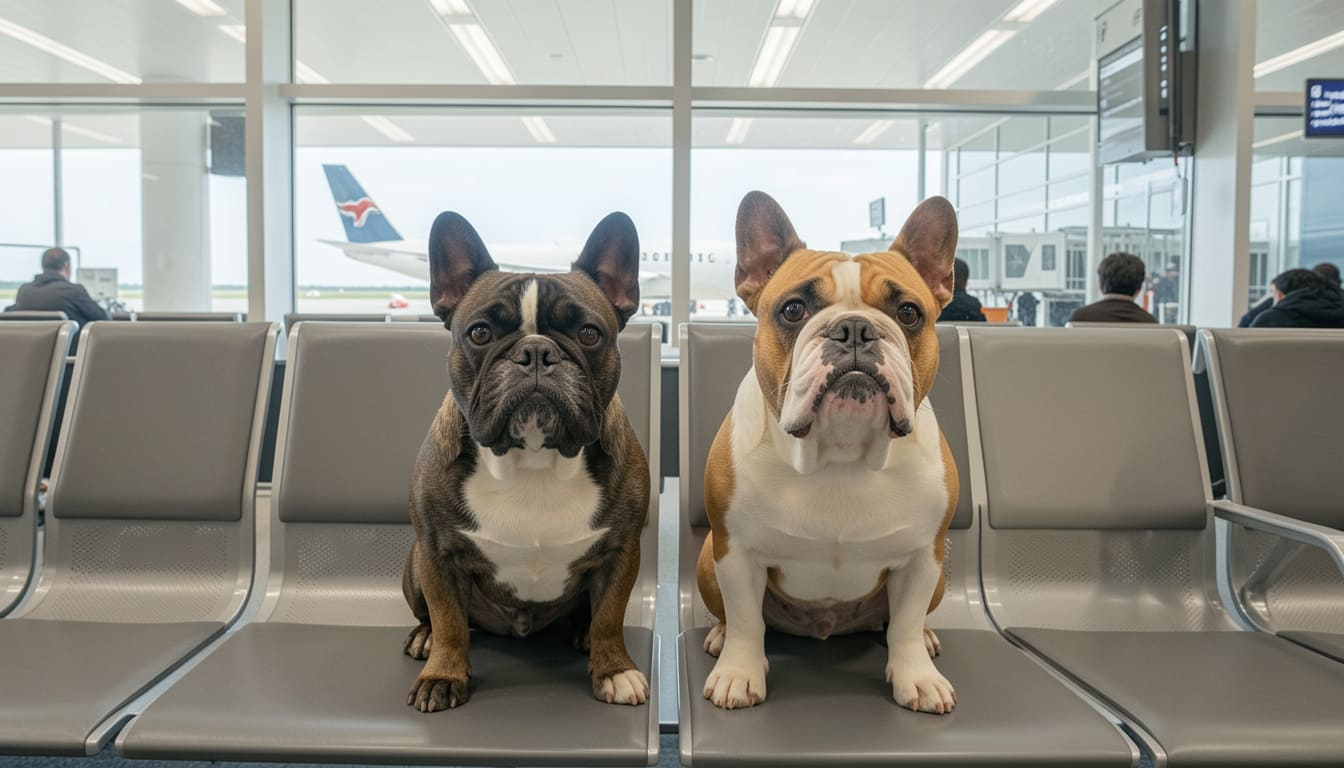
Why breed matters when shipping your pet from Canada
Not every pet can fly on every airline. Breed restrictions are one of the most common surprises Canadian pet owners encounter when planning an international move. If you own a brachycephalic (flat-faced) breed or a dog on certain countries’ restricted lists, your travel options narrow significantly.
Here is what you need to know about which breeds face restrictions, which airlines enforce them, and how to plan around them when shipping your pet from Canada.
Brachycephalic breeds: the most common restriction
Brachycephalic dogs and cats have shortened airways that make them more vulnerable to respiratory distress during air travel, particularly in the cargo hold where temperature and pressure fluctuations can occur. Most major airlines either restrict or ban these breeds from cargo travel.
Dog breeds commonly restricted
Breeds typically restricted from cargo travel include: English Bulldog, French Bulldog, Pug, Boston Terrier, Boxer, Pekingese, Shih Tzu, Cavalier King Charles Spaniel, Brussels Griffon, Japanese Chin, Tibetan Spaniel, Affenpinscher, and any mixed breed with a visibly shortened muzzle.
Cat breeds commonly restricted
Persian, Himalayan, Burmese, Exotic Shorthair, and British Shorthair cats face similar restrictions on many airlines.
Why the restriction exists
These breeds have a documented higher rate of respiratory incidents during air travel. Airlines face liability and animal welfare concerns, so most err on the side of restriction rather than risk. This is not a bureaucratic technicality. The breathing difficulty is a genuine safety concern, particularly at altitude and during temperature extremes.
Canadian airline policies for restricted breeds
Air Canada
Air Canada does not accept brachycephalic breeds in cargo at any time of year. Small brachycephalic pets may be allowed in-cabin if they meet the size requirements and the carrier fits under the seat. This is the strictest policy among major Canadian carriers.
WestJet
WestJet does not offer cargo pet transport. Pets on WestJet must fly in-cabin, and the airline has size and breed restrictions for in-cabin travel. Brachycephalic breeds that are small enough for in-cabin may be accepted, but check WestJet’s current policy before booking.
International carriers departing from Canada
If you are flying internationally from Toronto, Vancouver, or Montreal, you may have access to international carriers with different policies. Lufthansa, KLM, and some Asian carriers have their own breed restriction lists. Some are more permissive than Air Canada; others are stricter. The carrier, route, and season all factor in.
Country-level breed restrictions
Beyond airline restrictions, some destination countries ban or restrict certain breeds at the border:
The United Kingdom bans Pit Bull Terriers, Japanese Tosa, Dogo Argentino, and Fila Brasileiro under the Dangerous Dogs Act. Dogs of these breeds (or types) will not be allowed entry.
Australia bans Pit Bull Terrier, Dogo Argentino, Fila Brasileiro, Japanese Tosa, and Perro de Presa Canario. These breeds cannot be imported under any circumstances.
Germany classifies certain breeds as “dangerous” and requires special permits, insurance, and behavioral assessments. Breeds include American Staffordshire Terrier, Bull Terrier, Pit Bull Terrier, and Staffordshire Bull Terrier. Import is possible but involves extra steps and costs.
Singapore requires a special license for breeds it considers potentially dangerous and has outright import bans on some breeds.
These country-level restrictions apply regardless of how your pet arrives. Even if you find an airline willing to transport your dog, the destination country can refuse entry based on breed.
How to ship a restricted breed from Canada
If your pet is a restricted breed, here are the options Canadian pet owners typically explore:
In-cabin travel (if size allows)
If your brachycephalic pet weighs under 10 kg with the carrier, in-cabin travel avoids the cargo restrictions entirely. The pet stays with you in the cabin where conditions are climate-controlled and monitored. This is the safest option for flat-faced breeds and the simplest workaround.
Ground transport for domestic or cross-border moves
For moves within Canada or to the United States, ground transport in a climate-controlled vehicle avoids airline restrictions completely. Ground transport services drive your pet door-to-door. The trade-off is time: a drive from Toronto to New York takes 8 to 10 hours versus a 90-minute flight.
Routing through permissive airlines
Some international carriers still accept brachycephalic breeds in cargo on certain routes and during certain seasons (typically avoiding summer months). A relocation specialist with airline relationships can identify which carriers, routes, and dates are viable for your specific breed. This is where professional help makes the biggest difference.
Charter or shared charter flights
For overseas moves where no commercial airline will accept your pet, private charter is an option. It is expensive ($10,000 to $25,000+ CAD depending on route), but it eliminates both airline breed restrictions and cargo hold concerns. Some companies offer shared charters where multiple pets share a flight, reducing the per-pet cost.
Seasonal considerations for Canadian pet owners
Canada’s climate adds a layer of complexity. Even breeds that are normally accepted in cargo may face restrictions during extreme weather:
Winter cold embargoes affect departures from Canadian airports from roughly November through March. When ground temperatures at origin or destination drop below the airline’s cutoff (typically -7 to -12 degrees Celsius), cargo pet transport is suspended.
Summer heat embargoes at destination airports can also block travel. If your pet is flying cargo to a destination where ground temperatures exceed 29.5 degrees Celsius (85 degrees Fahrenheit), the airline may refuse to accept them.
For brachycephalic breeds that are already restricted, these weather embargoes further narrow the travel window. Planning 3 to 6 months ahead is essential to find a viable date.
Getting help with a restricted breed move
Ready to start planning your pet’s move?
Request a quote and we will put together a detailed plan and price for your specific route.
Prefer to talk? Give us a call at 1-877-707-1739.
Frequently asked questions
My dog is a mixed breed that looks like a restricted breed. Will that be a problem?
It can be. Airlines and customs authorities judge by appearance, not by DNA test. If your dog’s facial structure resembles a brachycephalic or banned breed, they may be classified as restricted. Having your veterinarian document the breed on the health certificate helps, but the airline or customs officer makes the final call.
Can I get a letter from my vet saying my brachycephalic dog is healthy to fly?
Some airlines previously accepted “fit to fly” certificates for brachycephalic breeds, but most major carriers have moved to blanket restrictions regardless of individual health status. A vet letter is unlikely to override an airline’s breed policy.
Are there size limits in addition to breed restrictions?
Yes. Even for non-restricted breeds, airlines have maximum crate dimensions and weight limits for cargo. Very large dogs (Great Danes, Saint Bernards, Irish Wolfhounds) may exceed the dimensions that standard aircraft cargo doors or climate-controlled compartments can accommodate. Check the airline’s specific size limits before booking.
Do breed restrictions apply to emotional support animals?
In Canada, there is no legal right to fly with an emotional support animal in the cabin. Only trained service dogs have protected access under Canadian Air Transportation Regulations, and they must meet the airline’s service animal documentation requirements. Breed restrictions apply to all other animals.