
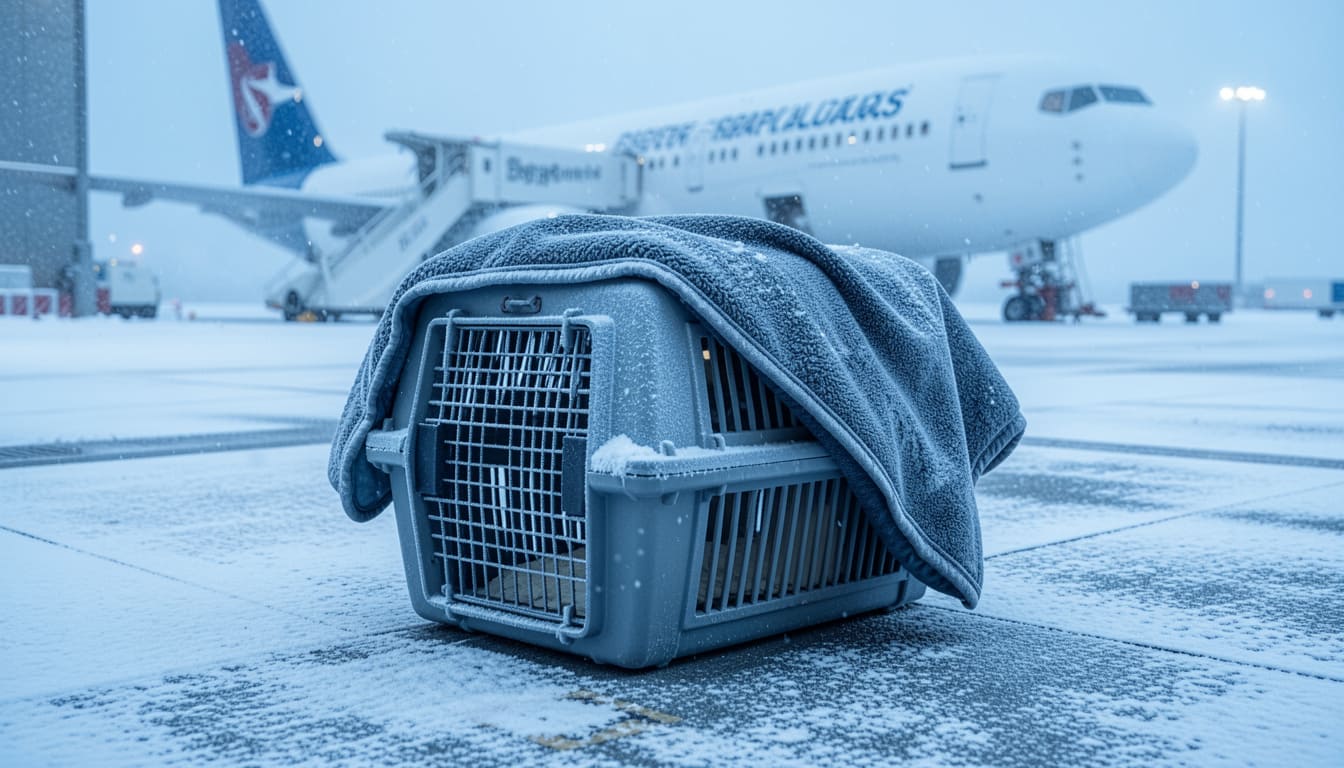
Why winter is the biggest challenge for pet shipping in Canada
While pet owners in the southern United States worry about summer heat embargoes, Canadian pet owners face the opposite problem: cold weather embargoes that can ground pet cargo transport for weeks at a time between November and March.
Airlines will not load live animals into cargo when ground temperatures at the origin or destination airport drop below their minimum threshold. In a Canadian winter, that threshold gets crossed regularly across every major airport in the country. Here is how cold embargoes work, which airports are affected, and how to plan your pet’s move around them.
How cold weather embargoes work
Airlines set temperature minimums for live animal transport. The specific cutoff varies by carrier:
Air Canada’s live animal program suspends cargo pet transport when ground temperatures at the origin or destination fall below -12 degrees Celsius (10 degrees Fahrenheit). Other carriers set their limits at -7 to -12 degrees Celsius.
The temperature is measured at ground level at the airport, not the forecast high for the day. Even if the afternoon high is -5 degrees, a morning departure when it is -15 degrees on the tarmac will be refused. The check happens at the time of loading, not at booking.
This means a flight booked weeks in advance can be cancelled on the morning of departure if the temperature drops below the limit overnight. This is the core planning challenge of winter pet shipping from Canada.
When embargoes typically hit each region
Western Canada
Vancouver (YVR) has the mildest winter of any major Canadian airport. Cold embargoes are rare here, with temperatures rarely dropping below -10 degrees. For pet owners in British Columbia, Vancouver is often the best winter departure point.
Calgary (YYC) and Edmonton (YEG) are a different story. Alberta winters regularly produce stretches of -20 to -35 degrees from December through February. Embargoes can last a week or more during cold snaps.
Central Canada
Toronto Pearson (YYZ) is Canada’s busiest airport for pet cargo. Winter temperatures in the GTA typically hover between -5 and -15 degrees from December through February, with periodic dips to -20 or colder. Embargoes here are intermittent but unpredictable.
Ottawa (YOW) and Montreal (YUL) are colder than Toronto and see more frequent embargo days. Montreal averages around -10 degrees in January, with cold snaps pushing below -20 regularly.
Atlantic Canada
Halifax (YHZ) has moderate winter cold with temperatures similar to Toronto, but winter storms and ice can cause additional delays beyond temperature embargoes. Flight cancellations from weather compound the embargo problem.
Prairies and Northern regions
Winnipeg (YWG) and Saskatoon (YXE) have the longest embargo seasons. Temperatures routinely drop below -20 from November through March. If you are shipping a pet from the Prairies in winter, ground transport to a milder departure point (like Vancouver or a U.S. hub) is often part of the plan.
Your options during embargo season
Wait for a weather window
Even in the coldest months, there are warmer days. A Chinook in Alberta can push Calgary from -25 to +5 in a matter of hours. In Toronto, a mid-winter warm spell might bring temperatures above zero for 3 to 4 days. These windows are your opportunity.
The downside: weather windows are not predictable more than 5 to 7 days out. You need to have all paperwork, crate, and airline booking ready to go so you can execute when a window opens. This requires a flexible travel date and a health certificate with as much validity remaining as possible.
Ground transport to a warmer departure point
If your origin airport is consistently too cold, driving your pet (or having a ground transport service drive them) to a warmer airport is a common strategy:
- Alberta pets can route through Vancouver (YVR), which rarely hits embargo temperatures
- Prairie pets can route south to a U.S. border hub like Minneapolis or Seattle
- Ontario pets in deep cold can wait for a Toronto window or drive to a U.S. hub like Buffalo or Detroit
Ground transport adds cost ($500 to $1,500 CAD depending on distance) but can be the difference between shipping in January and waiting until April.
In-cabin travel (for small pets)
Cold embargoes apply to cargo transport. Pets flying in-cabin with their owners are not subject to temperature restrictions because they enter and exit the aircraft through the jet bridge, never touching the tarmac. If your pet is small enough for in-cabin travel, winter is not a barrier.
Ship before November or after March
The most reliable approach is to plan your pet’s travel outside the peak cold months entirely. September through October and April through May are the sweet spots: mild enough to avoid cold embargoes at Canadian airports, and cool enough to avoid heat embargoes at destination airports in warmer climates.
The health certificate timing problem
Winter shipping creates a specific paperwork challenge. Most health certificates are valid for 10 days from the date of the veterinary exam. If your flight gets cancelled due to cold and you cannot rebook within that 10-day window, you need a new exam and a new CFIA endorsement.
This means additional vet costs ($75 to $200 per visit) and the risk of CFIA processing delays. During peak winter, having to redo the certificate is common enough that we budget for it in our timeline.
How we handle winter moves
When we coordinate a winter pet move from Canada, the plan accounts for embargo risk from the start:
- We identify the departure airport with the best odds of hitting a weather window
- We keep multiple flight dates on hold with the airline
- We schedule the vet visit and CFIA submission to maximize the certificate’s validity window
- We have ground transport options ready if the primary airport stays too cold
- We monitor forecasts daily as the travel window approaches
Ready to start planning your pet’s move?
Request a quote and we will put together a detailed plan and price for your specific route.
Prefer to talk? Give us a call at 1-877-707-1739.
Frequently asked questions
Can airlines make exceptions to cold embargoes?
No. Temperature embargoes are safety policies enforced by the airline’s live animal handling team. There are no exceptions, regardless of crate insulation, breed hardiness, or owner waivers. The temperature at the time of loading is the determining factor.
Is it safe for my pet to fly in cold weather if the cargo hold is heated?
The cargo hold is climate-controlled during flight. The risk is during ground handling: the time your pet spends on the tarmac being loaded and unloaded, and in the cargo facility between transfers. This exposure time, even if brief, is why airlines enforce temperature minimums.
How cold is too cold for ground transport?
Climate-controlled ground transport vehicles can operate in any temperature because the vehicle interior stays warm. The exposure risk is minimal (loading and unloading at each end). Ground transport is not subject to the same embargo rules as air cargo.
Should I put a heated pad or extra blankets in the crate?
Heated pads are not allowed in airline cargo crates (fire risk). Extra blankets and bedding are fine and recommended for warmth and comfort. A familiar blanket also helps reduce your pet’s stress.
What if I am moving in January and cannot wait until spring?
January moves from Canada are possible but require flexibility. We typically plan a 2 to 3 week window and execute when conditions align. If your pet is small enough for in-cabin, winter is not a factor at all. For cargo pets, Vancouver is the most reliable winter departure point.