
Pet Air Transport Explained: In-Cabin, Cargo, and Charter
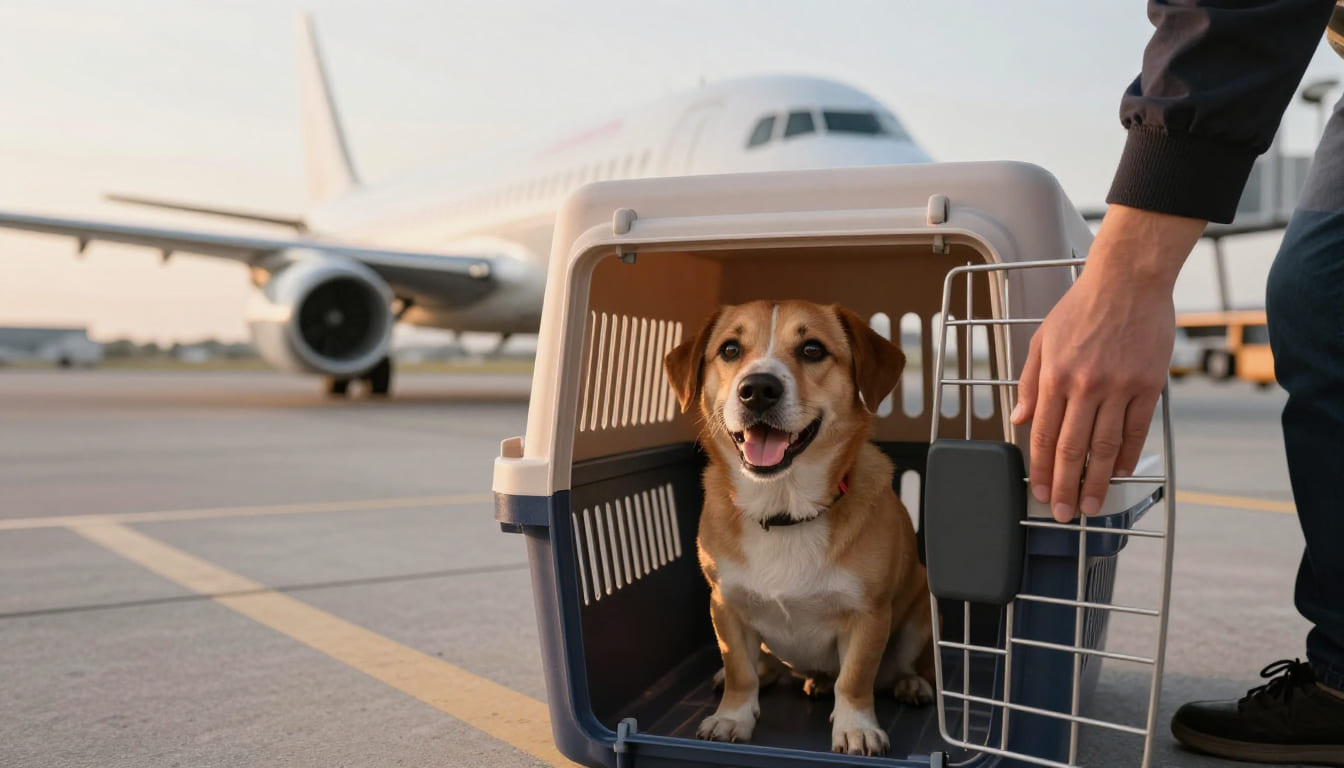
When people picture flying a pet, they usually picture one of three very different things: the small dog or cat under the seat in the cabin, the pet flying as manifest cargo in the hold, and the private charter for pets that cannot fly commercially. Knowing which one applies to your pet is the first real step in planning an air move. Here is how each works, what it costs, and how to make the flight as easy as possible.
The three ways a pet flies
- In-cabin: small dogs and cats whose carrier fits under the seat.
- Cargo: larger pets, in the hold. This is the standard for most dogs.
- Charter: for snub-nosed breeds and routes with no safe commercial option.
In-cabin: small pets only
If your pet and their carrier together fit under the seat in front of you, they may be able to fly in the cabin with you. Air Canada and WestJet each publish a carrier size. Air Canada’s general limit is 40 cm wide, 43 cm long and 20 cm high, with exceptions on some aircraft, and WestJet’s is 41 cm long, 21.5 cm high and 25.4 cm wide. Spots per flight are limited, so you book the pet when you book yourself. If you are flying Air Canada or WestJet, our guide to Air Canada and WestJet pet policies covers what each one allows.
Cargo: safe and widely misunderstood
Larger pets travel as cargo in the hold. Air Canada Cargo says the holds on its aircraft are pressurized and that most of them also have temperature-controlled compartments, and that where temperature control is needed but not available on the route booked, the booking agent suggests a different route or an alternate travel date. This is the part that worries owners most, so it is worth being clear: manifest cargo is a monitored, regulated service built specifically for live animals. It is not the baggage hold people picture. Your pet needs an airline-approved crate and, for most journeys, a health certificate, and the airline moves them under specific live-animal rules with temperature limits and handling standards.
Private charter: the exception, not the norm
Some pets cannot fly commercially. Air Canada will not take a snub-nosed dog in its baggage compartment. Some routes or timelines simply have no commercial option. A private or shared charter solves that, at a higher cost. It is rare, but it exists for the cases that need it. If your pet is a bulldog, pug, boxer, Persian, or another flat-faced breed, read our guide on breed restrictions before you book anything.
What affects the cost
Air transport pricing moves with your pet’s size and crate dimensions, the route and number of connections, the season, and whether you book it yourself or through a service that manages the airline, the crate, and the paperwork. A pet in cargo commonly runs a few hundred to a couple of thousand dollars in airline fees, with full-service coordination on top when you want it handled end to end. Our cost guide has the full breakdown.
How to make the flight easier on your pet
- Fly direct whenever you can. Connections are where delays and stress build up.
- Acclimate your pet to the crate for two to three weeks before travel.
- Avoid sedatives unless your vet specifically advises them, because they can affect breathing at altitude.
- Watch the season. In summer and winter, heat and cold embargoes can pause hold travel at temperature extremes. Our guide on winter pet shipping explains cold embargoes.
- Feed a light meal several hours before, not right before, and make sure the water dish is attached inside the crate.
Where a relocation service fits
Booking a pet on a flight involves crate sizing, airline live-animal rules, and timing that changes by season and route. That coordination is exactly what we do every day. Rather than decode it yourself, explore our pet transport services or request a quote and we will tell you the best way to fly your specific pet.
How pet transport works is set out for each route on one page, with the difference between cabin, checked baggage and cargo.
How airlines price a cargo flight: chargeable weight
Cargo pricing is the part that surprises people most. Airlines bill live animals on chargeable weight, the greater of two numbers: the actual weight of pet plus crate, and the volumetric weight calculated from the crate dimensions. Air Canada publishes the divisors it uses, 6,000 for centimetres to kilograms. For pets, the crate volume almost always sets the price. A large crate can calculate out near 67 kilograms of volumetric weight when the dog and crate together weigh 45, and the airline bills the 67.
That makes crate size, not the dog’s weight, the biggest cost lever on an air move, and it is why a proper crate fitting comes before any accurate quote.
The Canadian carrier picture
- Air Canada Cargo: the main Canadian live animal program. Air Canada Cargo holds IATA’s CEIV Live Animals certification, which it renewed in 2022. In the cabin it is $50 to $60 CAD each way within Canada and to the United States, and $100 to $120 CAD on other international routes. For the hold, Air Canada Cargo does not publish a route rate for dogs and cats. It quotes each shipment through a sales representative.
- WestJet: accepts pets on many routes. In the cabin it is $50 to $59 CAD each way within Canada and the United States, and $100 to $118 CAD outside that. As checked baggage it is $100 to $118 CAD within Canada and the United States, and $200 to $236 CAD outside. Pets travelling alone go through WestJet Cargo.
- International lanes: often built on Air Canada or on foreign flag carriers with strong live animal programs, depending on the destination.
Two fee lines to expect beyond freight: an airline terminal or handling fee, around $80 CAD at Air Canada facilities, and destination airport handling. Frankfurt’s Animal Lounge, a common European transfer point, publishes handling near 480 euros plus a vet clearance fee of about 200 euros. A complete quote lists these up front.
If the Dog Is Large, the Answer Changes Before You Book
Everything above applies to any animal. A large dog meets three additional constraints, and from Canada the first one is the one nobody expects.
Air Canada requires an IPATA, IATA or ATA registered agent for international and US pet cargo out of Canada. So for a large dog leaving the country in the hold, a Canadian family cannot make the booking themselves, however organized they are. That is not a service being sold to you, it is the carrier’s condition, and it is the single biggest structural difference between moving a large dog from Canada and moving one from the United States.
The second is the cabin. Some airlines publish a weight for the pet and carrier together, and the figures vary. In the pet carrier size checker on our US site, Air Transat gives 8 kg, Flair 23 lb, Calm Air and Pascan 20 lb, and Pacific Coastal, Central Mountain Air and Air Inuit 22 lb, or 10 kg. For the other Canadian airlines it holds limits for, it has a carrier size and no weight figure. Whatever an airline’s weight limit, a dog large enough to need more headroom than a case that fits under a seat cannot stand and turn around inside one.
The third is the crate, and for a large dog it is the most expensive decision in the move. Cargo is priced on the crate’s outside dimensions rather than on the dog, so a crate one size larger than needed can move the booking into a higher band and cost more than switching routes would have saved. Sizing up out of kindness is not kindness. Our guide to what size crate a pet needs to fly from Canada gives the published formula and the two Air Canada limits that sit on top of it. Meet the stand, turn and lie down requirement exactly.
Two Canadian realities then sit on top. The winter and summer windows described above bite harder on a large crate, because it spends longer on the ramp at both ends. And Air Canada’s soft-sided carrier rule for the cabin, in force since 1 June 2025, is irrelevant to a large dog for the obvious reason but catches families who assumed the dog might squeeze into the cabin after all.
The practical order is the same one that works everywhere, with a Canadian first step: confirm which agent-served lanes exist for your route, then check breed against both the airline and the destination, then measure the dog and size the crate, and only then price anything. Our Air Canada pet policy guide covers the carrier side and our guide to banned and restricted dog breeds by country covers the rule that can end the plan outright.
Winter and summer windows
Canadian air moves plan around temperature at both ends. Cold-weather embargoes stop cargo acceptance in the deepest winter weeks, and summer heat rules restrict midday departures in hot months. Shoulder seasons book easiest. If the calendar is fixed in January or July, ground transport within North America is the reliable fallback, covered in our ground transport guide.
Frequently asked questions
Is cargo safe for pets?
Yes. Manifest cargo is a monitored service designed for live animals. It is not the same as checked baggage. Air Canada Cargo says the holds on its aircraft are pressurized and that most of them also have temperature-controlled compartments, and that where temperature control is needed but not available on the route booked, the booking agent suggests a different route or an alternate travel date.
Can my dog fly in the cabin?
Only if the pet and carrier fit under the seat. Air Canada and WestJet each publish a carrier size. Air Canada’s general limit is 40 cm wide, 43 cm long and 20 cm high, with exceptions on some aircraft, and WestJet’s is 41 cm long, 21.5 cm high and 25.4 cm wide. Larger dogs travel as cargo.
Why would a pet need a private charter?
Snub-nosed breeds and certain routes have no safe commercial option. A charter fills that gap when commercial flying is off the table.
Should I sedate my pet for a flight?
Usually no. Most vets and airlines advise against sedation for air travel because it can affect breathing and balance at altitude. Ask your vet about your specific pet.
Why is my quote based on the crate and not my dog’s weight?
Because airlines bill on chargeable weight, and for pets the volumetric weight of the crate nearly always exceeds the real weight on the scale. Same flight, same dog: a size larger crate means a larger bill.
What does in-cabin cost on Canadian airlines?
Air Canada and WestJet both price per direction. In the cabin it is $50 to $60 CAD within Canada and to the United States, and $100 to $120 CAD on other international routes, for a small pet in an approved carrier under the seat. International in-cabin fees run higher and vary by route.
Are there fees beyond the airline freight rate?
Usually. Expect a terminal or handling fee, around $80 CAD at Air Canada cargo facilities, and handling charges at some destination airports, such as roughly 480 euros plus vet clearance at Frankfurt’s Animal Lounge. Ask for these lines in writing with any quote.
Can my pet fly without me
Yes, but the Canadian list of carriers is shorter than the American one. Air Canada Cargo carries unaccompanied animals under its AC Animals service, and for international and United States routes out of Canada it requires the booking to be made through a registered IPATA, IATA or Animal Transportation Association agent, with domestic Canadian shipments the exception.
American Airlines Cargo, which many people find first because it is the largest publicly available option in the United States, transports no animals outbound from Canada at all. So on a Canadian departure the question is usually which carrier serves the lane and who is permitted to place the booking, rather than whether the animal can travel. Our Air Canada pet policy guide sets out the fees, the carrier rules and the seasonal restrictions.
Related guides
Ready to plan your pet’s move?
Tell us your pet’s size and route. Request a quote and we will reply with a plan, a timeline, and clear next steps.
Sources
Checked August 2026.
- Air Canada Cargo, charges and fees. The terminal fee, the security screening fee, the comfort stop conditions, and the Frankfurt Animal Lounge handling and veterinary clearance charges.
- WestJet, pets. WestJet own rules for pets in the cabin and in the hold, and the entrance requirements it expects guests to meet.
- IATA, live animal handling and transport. The Live Animals Regulations, the worldwide standard airlines work to.
The United States is the most common destination from Canada and has the least paperwork of any international route. Our guide to flying a pet from Canada to the United States sets out the CDC form, the six month age rule and the cabin, baggage and cargo fork.
Last updated