
Canadian Airline Pet Policies: A Guide to Flying With Your Pet
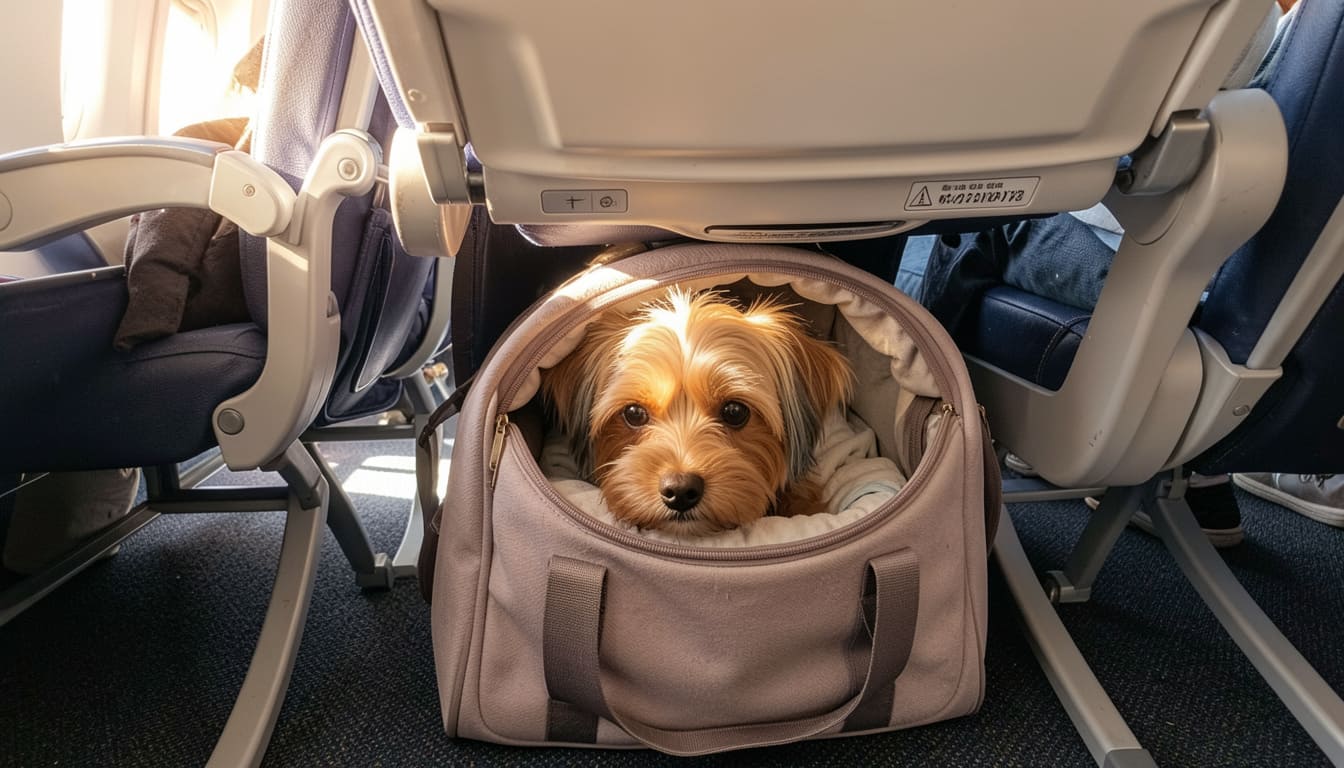
How Canadian airlines handle pet travel in 2026
If you are flying with your pet from Canada, your airline options and their pet policies are the first thing to sort out. Canadian carriers have different rules for in-cabin pets, cargo transport, and which routes allow animals at all. International carriers departing from Canadian airports add more options but also more complexity. The pet carrier size checker on our US site sets IATA’s minimum for your dog or cat beside the under-seat limits that Canadian and US airlines publish.
Here is a straightforward comparison of the policies that matter most when you are planning a pet move.
Air Canada
In-cabin pets
Air Canada allows small dogs, cats, and birds in the cabin on most domestic and international flights. Your pet must fit in a carrier that slides under the seat in front of you, and since 1 June 2025 that carrier has to be soft-sided. Maximum dimensions depend on the aircraft, running from 40 x 43 x 20 cm up to 40 x 55 x 27 cm, so check the limit for your specific aircraft before you buy a carrier. Source: Air Canada, Travelling with your Pet, checked August 2026.
The fee is $50 to $60 CAD each way within Canada and to the United States, and $100 to $120 CAD on international routes. You can add a pet to your reservation online or by calling Air Canada directly. Only one pet carrier is allowed per passenger, and there is a limit on the total number of pets per flight.
Cargo transport
Air Canada offers live animal transport through their cargo division (Air Canada Cargo) for pets too large for in-cabin travel. Cargo pet transport is available on select routes, subject to aircraft type, temperature, and seasonal restrictions.
Air Canada Cargo does not publish a route rate for dogs and cats. It quotes each shipment through a sales representative, priced on the route, the animal, and the greater of the actual or dimensional weight of animal plus crate. The fees it does publish are the add-ons: a terminal fee of $80 CAD per shipment within Canada, and a security screening fee of $0.17 CAD per kg with a $20 minimum. Air Canada Cargo requires an IATA-compliant crate and a health certificate.
Key restriction: Air Canada will not take a snub-nosed dog in its baggage compartment. Air Canada Cargo names snub-nosed breeds as restricted and says they must be tendered through a listed company approved by the International Pet and Animal Transportation Association.
Air Canada publishes its winter rules by aircraft and temperature. From 1 November to 31 March, and whenever it is 0 °C or below, it accepts no cats or dogs under 4.5 kg in the baggage compartment of any of its aircraft and advises against animals as checked baggage on its Airbus A319, A320 and A321, whose cargo compartment is not heated. From November to March its Boeing 737 MAX 8 takes no cats or dogs in the baggage compartment at all.
Routes and availability
Air Canada operates from all major Canadian airports. For cargo pet transport, the available routes depend on aircraft type. Direct international routes from Toronto Pearson, Vancouver, and Montreal offer the most cargo pet options.
WestJet
In-cabin pets
WestJet allows small dogs and cats in the cabin on domestic and select international flights. The carrier must be soft-sided and no larger than 41 cm x 21.5 cm x 25.4 cm. WestJet publishes no combined weight limit for cabin pets, only that size limit and the rule that your pet can stand, turn around and lie down.
The fee is $50 to $59 CAD each way for flights within Canada and to the United States, which WestJet prices as a single bucket, and $100 to $118 CAD on other international routes. The ranges are tax driven. Source: WestJet, checked August 2026. WestJet requires you to call to add a pet to your reservation (it cannot be done online).
Cargo transport
On WestJet, an animal too large for the cabin travels as checked baggage, and an animal travelling without its owner goes through WestJet Cargo, which quotes separately. The airline crate size calculator on our US site works out IATA’s minimum inside dimensions for your dog or cat’s travel crate.
Routes and limitations
WestJet primarily serves domestic Canadian routes and select international destinations (U.S., Mexico, Caribbean, UK, select European cities). Their narrower international network means fewer options for overseas pet moves compared to Air Canada.
Porter Airlines
In-cabin pets
Porter Airlines accepts small dogs and cats in the cabin on most flights. Porter takes house cats and small dogs only, in a soft-sided carrier no larger than 55 cm x 40 cm x 27 cm. It publishes no weight limit. The fee is $50 plus tax each way, and only two pets travel per flight, so book early.
The one worth checking first: Porter carries no pets in the hold on any flight. If your pet is too big for the cabin, Porter is not an option at all. Source: Porter, checked August 2026. Porter’s Toronto City Centre (Billy Bishop) airport base is convenient for GTA residents, though the island airport’s shorter runways mean smaller aircraft and fewer international routes.
Porter has expanded with Embraer E195-E2 aircraft out of Toronto Pearson, offering more routes. Check Porter’s current pet policy for your specific route, as it may vary by aircraft type.
Cargo transport
Porter does not offer cargo pet transport.
International carriers from Canadian airports
Major international airlines departing from Toronto, Vancouver, and Montreal each have their own pet policies. Here are the carriers most relevant for pet shipping from Canada:
British Airways
BA operates direct flights from Toronto, Vancouver, and Montreal to London Heathrow. They accept pets in cargo through their partner IAG Cargo. Brachycephalic breed restrictions apply. BA does not allow pets in-cabin except for assistance dogs.
Lufthansa
Lufthansa flies from Toronto, Vancouver, and Montreal to Frankfurt, with connections across Europe. Their cargo pet program (via LH Cargo) is well-regarded. Pets over 8 kg travel in cargo; under 8 kg may fly in-cabin. Lufthansa accepts some brachycephalic breeds in cargo with restrictions.
KLM
KLM operates from Toronto and Montreal to Amsterdam. They accept pets in-cabin (up to 8 kg with carrier) and in cargo. KLM also accepts some brachycephalic breeds, though with seasonal and route limitations.
Cathay Pacific
For moves from Vancouver to Asia, Cathay Pacific flies to Hong Kong with connections throughout Asia. They accept pets in cargo but not in-cabin. Their live animal program has specific crate and documentation requirements.
Japan Airlines (JAL) and All Nippon Airways (ANA)
Both carriers operate Vancouver to Tokyo routes and accept pets in cargo. Japan’s import requirements are extensive regardless of carrier, but direct flights minimize transit stress.
Booking tips for pet travel from Canada
Book early. Air Canada allows one cat or small dog in the cabin per passenger, and WestJet one pet per guest. Both also limit how many pets travel on each flight. During summer and holiday periods, pet spots fill up weeks in advance.
Call the airline directly. Even if the airline allows online pet bookings, calling confirms the pet is registered on your specific flight and that the aircraft type supports pet transport.
Confirm your route supports pets. Code-share flights and certain aircraft types may not allow live animals. The booking agent can verify this.
Ask about temperature restrictions. Get the airline’s specific cold and heat embargo thresholds so you know what conditions would cancel your pet’s transport.
Check destination requirements separately. Airline pet policies cover transport rules. The destination country’s import requirements (health certificates, vaccinations, permits) are a separate layer of requirements you must also meet.
When to use a relocation service instead of booking directly
For in-cabin domestic travel with a small pet, booking directly with the airline is straightforward. Where professional help adds value: international cargo shipments, restricted breeds that need alternative routing, complex destinations with extensive paperwork, and winter moves that require weather-window flexibility.
Ready to start planning your pet’s move?
Request a quote and we will put together a detailed plan and price for your specific route.
Prefer to talk? Give us a call at 1-877-707-1739.
Sources
Airline pet rules change without much warning, so every figure here was checked against the carrier in August 2026. Confirm with the airline before you book.
- Air Canada, Travelling with your Pet. Note the soft-sided carrier requirement in effect since 1 June 2025, and that cabin carrier dimensions vary by aircraft.
- WestJet, Pets, and its general entrance requirements.
- CFIA, Pets: Export certificates, for the paperwork side of any flight leaving Canada.
Frequently asked questions
Can I book my pet on a flight without booking a seat for myself?
For in-cabin travel, no. Your pet must be accompanying a ticketed passenger. For cargo transport, yes. Your pet can fly as manifested cargo without you being on the flight. This is how most professional pet relocation shipments work.
What if my pet is too big for in-cabin but my airline does not offer cargo?
You will need to use a different airline for the pet transport or arrange dedicated cargo transport through a pet relocation service. Your pet does not need to fly on the same airline or even the same day as you.
Are there direct cargo pet routes from Canada to Australia?
There are no direct flights from Canada to Australia. Pets typically route through a hub (Los Angeles, Hong Kong, or Singapore depending on the carrier). The connection adds transit time but is the standard route for Canadian pets heading to Australia or New Zealand.
Do I need to sedate my pet for the flight?
WestJet Cargo says tranquilization is not recommended, but if necessary, a notice from the administering veterinarian is required at the time of tender, along with a sedation record. Sedation can affect your pet’s ability to regulate body temperature and balance, increasing risk in the cargo hold. If your pet has severe travel anxiety, discuss non-sedative options with your vet.
Moving between October and March? Our guide to fall and winter pet travel embargoes from Canada covers the station closures, the one-hour tender window and the CFIA timing that decide whether a booking survives the season.
Our Air Canada pet policy guide covers the cabin carrier rule that changed, the winter and summer bans on the baggage compartment, and the agent requirement on every cargo booking to the United States.
Our WestJet pet policy guide does the same for the other Canadian carrier: the fee table in both directions, the 41 cm cabin kennel maximum, the 48 hour space request, and the rule that excludes a pet from any itinerary containing a partner-operated segment.
Last updated